Root canal treatment in Baku
Root canal treatment removes the inflamed nerve inside a tooth so the tooth itself can be saved. It is done under local anaesthetic, so it usually does not hurt.
from 100 AZN, 1 toothThe exact price is clear after the examination.

Does this sound familiar?
- My tooth aches by itself, especially at night
- After something cold or hot the pain lasts a long time
- My tooth hurts when I bite or touch it
- The gum next to my tooth is swollen, with a bump like a pimple
- My tooth has turned darker
Sometimes the tooth does not hurt at all and the inflammation only shows on an image. That is why, if needed, a panoramic X-ray or a 3D scan is taken at the clinic before treatment.
What is root canal treatment?
Diagram: a tooth before and after root canal treatment
- Deep decay has reached the nerve.
- The inflamed nerve (pulp) in the crown and in the root canals.
- After treatment the canals are cleaned and filled to the tip of the root.
- The top of the tooth is sealed with a filling.
Inside each tooth there is soft tissue with a nerve and blood vessels. When decay goes deep or a tooth is injured, this tissue becomes inflamed. This is called pulpitis.
People often call it "removing the nerve": the inflamed tissue is removed, the canals are cleaned and filled, and you keep the tooth.
How does root canal treatment go?
A root canal is usually done in one visit. Sometimes, depending on the state of the tooth, it is advisable to wait a while between the canal treatment and the final filling.
- How many visits
- Usually it is done in one visit. Sometimes you come back once more for the final filling.
- Does it hurt
- It is done under local anaesthetic, so it usually does not hurt during the treatment. For a few days afterwards the tooth can be tender when you bite.
Examination and scan
The tooth is examined. If needed, a panoramic X-ray or a 3D scan is taken right at the clinic.
Anaesthesia
Local anaesthesia is given, so it usually does not hurt during the treatment.
Cleaning the canals
The inflamed tissue is removed, then the canals are cleaned and disinfected.
Filling the canals
The cleaned canals are filled.
Rebuilding the tooth
Then the top of the tooth is rebuilt with a filling. Sometimes it is better to wait a while first.
After the treatment
- For a few days the tooth can be tender when you bite. That is normal and usually passes by itself.
- If you need a painkiller, take one that suits you, following the instructions.
- If the pain gets worse every day or swelling appears, send a message on WhatsApp straight away.
What does the price of a root canal depend on?
Root canal treatment starts at 100 AZN per tooth. The exact amount is given after the examination, before any work starts.
What changes the price
- The state of the tooth and how severe the inflammation is
- Whether the canal was treated before: re-treatment takes more work
- The filling on top of the tooth afterwards
Frequently asked questions
Does root canal treatment hurt?
It is done under local anaesthetic, so it usually does not hurt during the treatment. Once the anaesthetic has taken effect, the inflamed tissue is removed, and the canals are cleaned and filled. For a few days afterwards the tooth can be tender when you bite. That is normal and usually passes by itself.
How much is root canal treatment?
Root canal treatment starts at 100 AZN per tooth. The price depends on the state of the tooth and whether the canals have been treated before. The exact amount is given after the examination, before any work starts, and you are also told in advance whether the filling on top is included.
How many visits does a root canal take?
Usually it is done in one visit. Sometimes, depending on the state of the tooth, it is advisable to wait a while between the canal treatment and the final filling, and then you come back once more for the filling.
Do I need a root canal if the tooth does not hurt?
Sometimes, yes: a tooth may not hurt at all while the inflammation shows only on an image. Whether you need it becomes clear at the examination, with a panoramic X-ray or a 3D scan if needed.
Why is the nerve removed?
An inflamed nerve does not heal by itself: over time it dies, and the inflammation spreads to the tip of the root and the bone. Removing the nerve and cleaning the canals is how the tooth is saved.
Is there pain after a root canal?
For a few days the tooth can be tender when you bite. That is normal and usually passes by itself. If you need a painkiller, take one that suits you, following the instructions. If the pain gets worse every day or swelling appears, send a message on WhatsApp straight away.
What happens to a tooth after the nerve is removed?
The tooth stays in your mouth and chews like any other, it just no longer feels hot and cold. Over time a tooth without a nerve can become more brittle and darker, so its top should be restored soon after treatment.
Sometimes a tooth is too broken down to save. In those cases you are told openly.
Read in more detail
Why does the nerve of a tooth get inflamed?
The nerve sits under the enamel and dentine, in the deepest part of the tooth. When bacteria reach it, or the tooth takes a hard knock, the nerve becomes inflamed. A tooth is a closed space with hard walls, so the swollen tissue has nowhere to go. That is why this pain is often severe.
In the early stage the inflammation can settle. If the decay is removed in time, the nerve often calms down and a filling is enough. If the inflammation goes on, the nerve cannot recover, and you need root canal treatment.
- Deep decay The most common cause. Untreated decay slowly works its way down to the nerve.
- Decay under an old filling When the edge of a filling opens up, bacteria get in and the decay spreads unseen.
- A knock or a crack Even if the tooth does not break, the nerve can be damaged. Sometimes this only shows up much later.
- Repeated large work on the same tooth Every deep treatment puts more strain on the nerve.
What are root inflammation and a cyst?
If an inflamed nerve is not treated, it dies over time. The infection travels down the canals and causes inflammation at the root tip, in the bone. This is called inflammation of the root (periodontitis).
When the inflammation lasts a long time, a small sac can form at the root tip, usually called a cyst. A cyst often causes no pain and is found by chance on an X-ray. After root canal treatment, a small area of inflammation usually heals slowly, and this can take months.
That is why it is usually advised to have the tooth checked again some time after treatment.
What happens if you put off root canal treatment?
When the pain stops, it most often means the nerve has died, not that the tooth has healed. An untreated tooth usually goes through these stages:
This does not happen at the same pace in every tooth. The infection is not only the tooth's problem: it can spread to the tissues around it. Swelling, a temperature or trouble swallowing should not wait.
- The pain comes and goes First with cold and heat, then on its own at night.
- The pain suddenly stops The nerve has died, but the infection stays and moves towards the root.
- Biting hurts and a small blister appears on the gum: the inflammation has reached the root tip.
- The gum or cheek swells Pus has built up. This should not wait.
- The bone wears away and the tooth breaks down At some point the tooth may be too damaged to save.
Why does the top of the tooth matter after treatment?
Filling the canals is not the end of the work. The filling on top protects the canals from the bacteria in the mouth. If it does not seal well, or a temporary filling stays in too long, bacteria can get back into the canals and the treatment may need to be redone.
During treatment the tooth is opened and its walls get thinner, so it can crack under heavy load. With small or medium damage a filling is usually enough. A tooth with very thin walls is usually covered with a crown to stop it splitting. Such a tooth gets a zirconia crown.
- If you have a temporary filling, do not chew anything hard on that side until the next visit.
- Do not bite nuts, bones, ice or other hard things with a treated tooth.
The dentist's courses in this field
- years of experience, since 2004
- 20+
- courses and conferences in this field
- 6
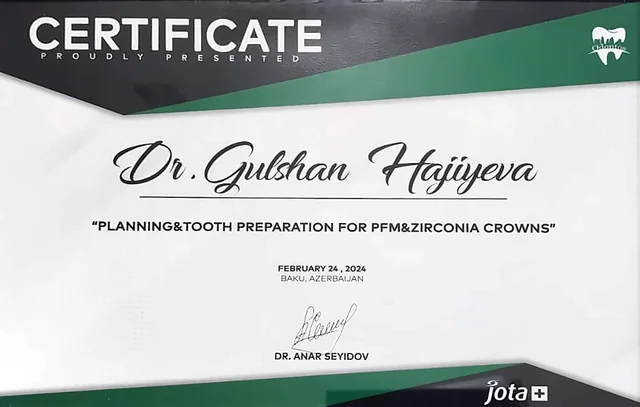
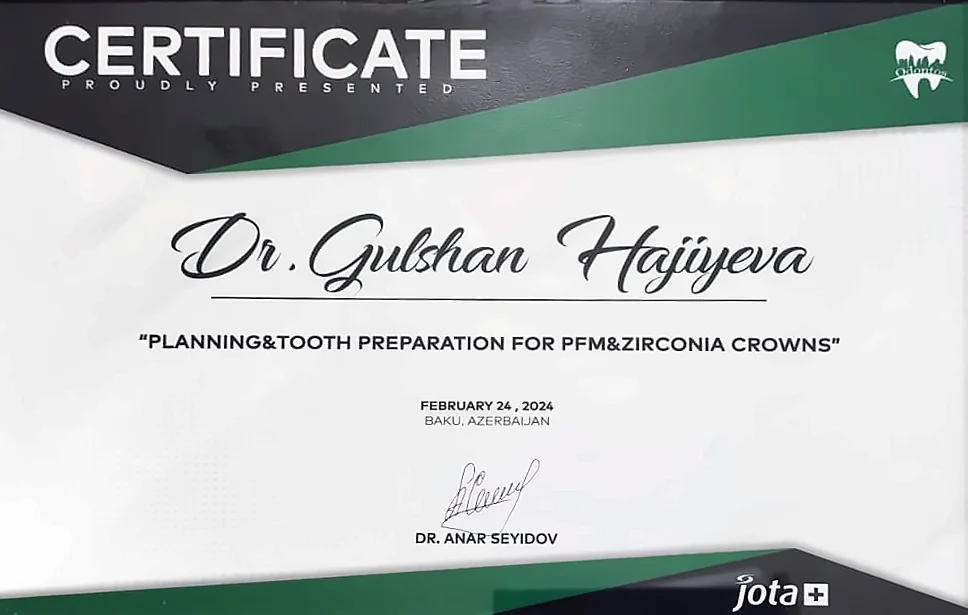
Course on planning and tooth preparation for metal-ceramic and zirconia crowns.
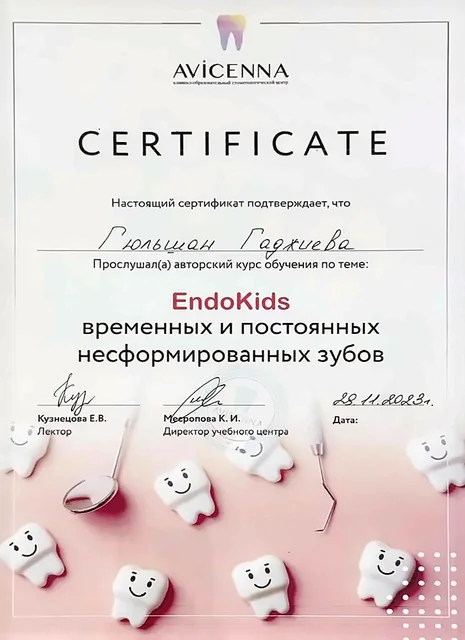
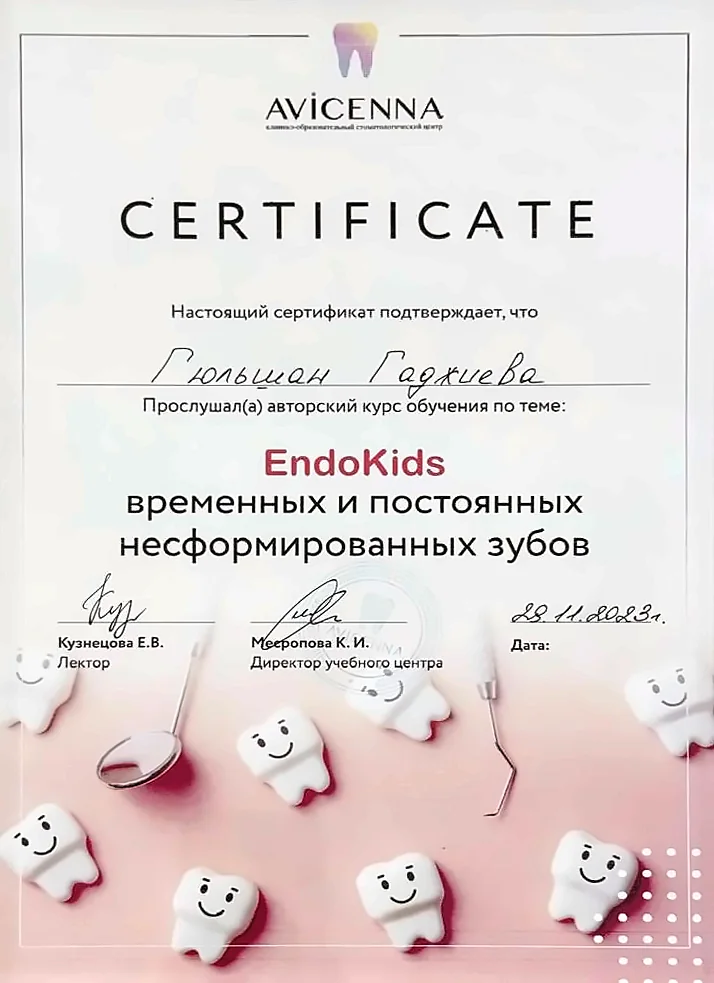
Course on root canal treatment of baby teeth and young permanent teeth with unformed roots.
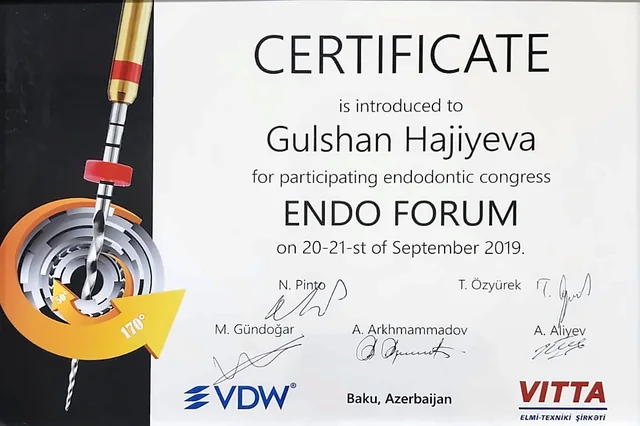
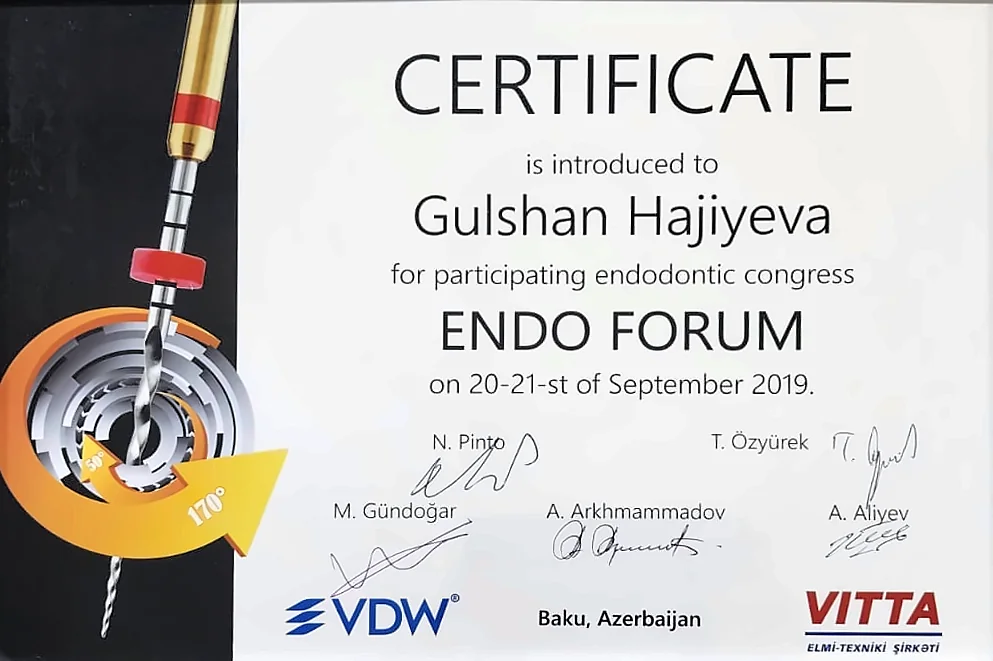
Endodontic congress.

Lecture on planning and diagnosis in endodontics and a hands-on course on shaping root canals with NiTi files.
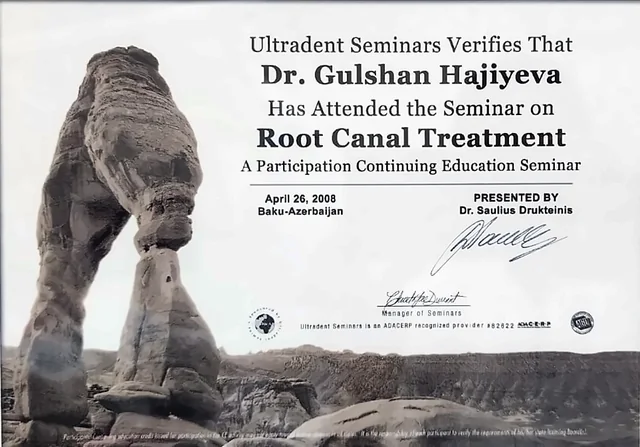
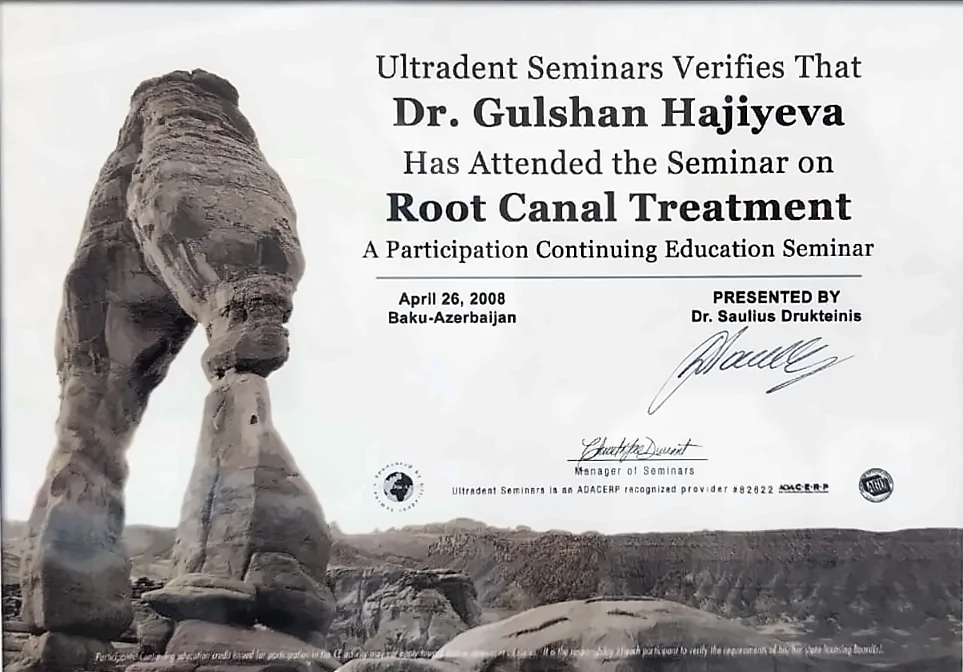
Ultradent continuing education seminar on root canal treatment.
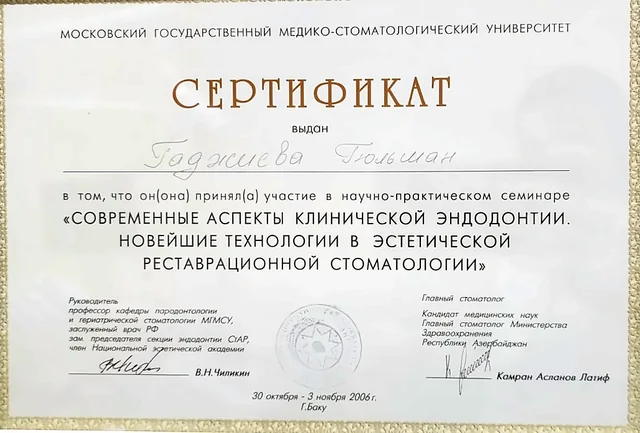
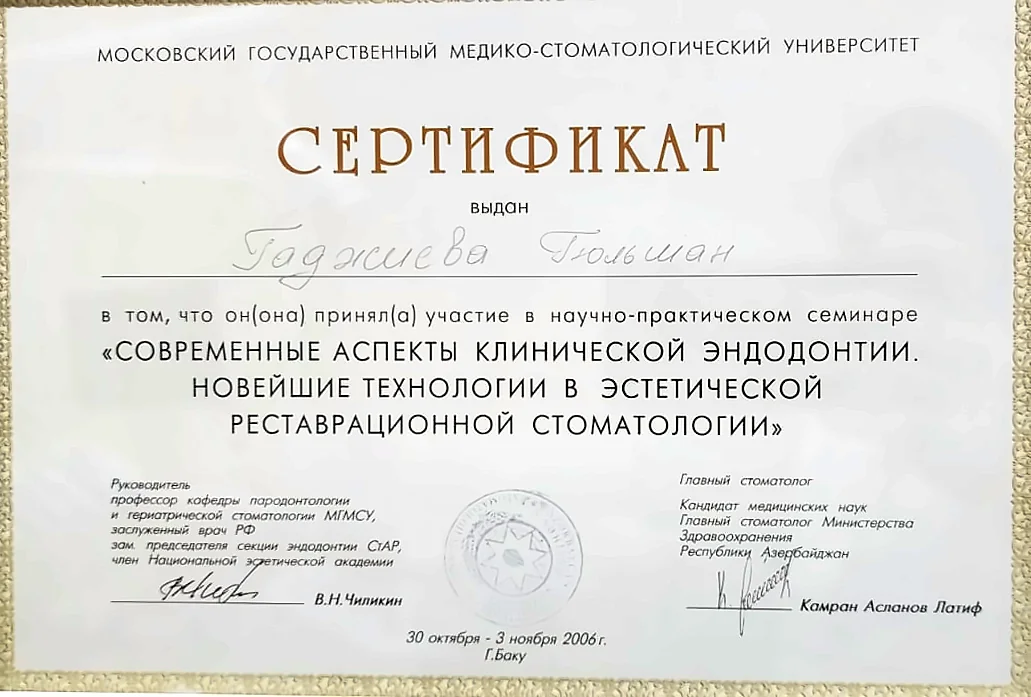
Scientific and practical seminar on clinical endodontics and aesthetic restoration (Moscow State University of Medicine and Dentistry).

- 2026
Certificate to practise
State certificate to practise, dentistry
- 2002
University
Azerbaijan Medical University named after N. Narimanov
Other services

Does a tooth ache at night?
Do not wait: the sooner the inflammation is treated, the better the chance of saving the tooth. Send a message on WhatsApp.