Fillings and tooth decay treatment in Baku
The decay is removed and the tooth is rebuilt with a tooth-coloured filling. A filling placed early saves the tooth. If you wait too long, you may need root canal treatment.
from 70 AZN, 1 toothThe exact price is clear after the examination.

Does this sound familiar?
- There is a dark spot or a hole in my tooth
- My tooth twinges briefly with sweet or cold food
- Food keeps getting stuck between my teeth
- My old filling fell out or has gone dark at the edge
- A piece of my tooth has broken off
- I do not like the shape, colour or gap of my front teeth
If the pain lasts, starts by itself at night, or the tooth hurts when you bite, the inflammation has often reached the nerve. A filling alone may then not be enough.
What is a filling?
A filling closes the hole left when the decay is cleaned out. The same composite material is also used for composite veneers on front teeth.
Decay destroys a tooth slowly. Small decay is usually easier and cheaper to treat.
If a tooth is too broken for a filling to hold, it can be restored with a crown. Zirconia crowns
How is a filling placed?

- Does it hurt
- The filling is placed under local anaesthetic. Once it works, you usually feel pressure and vibration rather than pain.
Examination
The tooth is examined to see how deep the decay goes. The price is given once the tooth has been seen.
Removing the decay
The decayed tissue is cleaned out of the tooth. A filling only goes into a clean cavity.
Placing the filling
The shade is matched to your tooth, and the material is placed in layers and hardened with a special light.
After a filling
- For a few days the tooth can be sensitive to cold and to biting. That is normal and usually passes by itself.
- If biting hurts, the filling may be too high. This is fixed in a short visit.
- If the pain gets worse, starts at night or lasts longer than a week or two, send a message on WhatsApp.
- A temporary filling has to be replaced with a permanent one in time.
What does the price of a filling depend on?
A filling starts at 70 AZN per tooth. The exact amount is given once the tooth has been examined.
What changes the price
- The size of the decay
- Where the tooth is: front or back
- The filling material
Examples of fillings
These photos are shared with the patients' permission.


Drag left and right, or use the arrow keys.
Frequently asked questions
How much is a filling?
A filling starts at 70 AZN per tooth. The price depends on the size of the decay, where the tooth is and the material. The exact amount is given after an examination. Small decay is usually easier and cheaper to treat, so do not put it off.
Why does my tooth hurt after a filling?
For a few days after a filling the tooth can be sensitive to cold and to biting. That is normal and usually passes by itself. If the filling is too high, biting hurts: this is fixed in a short visit. If the pain gets worse, starts at night or lasts longer than a week or two, send a message on WhatsApp: sometimes the inflammation has already reached the nerve.
Will getting a filling hurt?
The filling is placed under local anaesthetic. Once it works, you usually feel pressure and vibration rather than pain. If you feel anything, give the dentist a sign and more anaesthetic is added. Some sensitivity for a day or two afterwards is normal.
Will a tooth-coloured filling show?
A well-placed tooth-coloured filling does not show. Its shade is matched to your tooth, and the material is placed in layers and hardened with a special light. A filling like this takes the chewing load together with the tooth. That is why it is the kind placed most often today.
What is a temporary filling?
A temporary filling stays for a few days or weeks, for example between root canal visits. It does not replace a permanent filling and has to be replaced in time. So please do not put off your next visit.
Can I have a filling while pregnant?
Yes, and it is often needed: untreated inflammation in pregnancy is more dangerous for mother and baby than the treatment itself. The most comfortable time for planned treatment is usually the second trimester, but pain should not wait. Always say that you are pregnant: the local anaesthetic is chosen with that in mind, and an image is taken only when it is really needed.
Why do teeth decay?
Plaque builds up on the teeth every day. Its bacteria turn sugary and starchy food into acid, and the acid slowly breaks down the enamel. Snacking on sweets through the day, brushing rarely and skipping the gaps between teeth speed decay up. Small decay does not hurt, so regular check-ups are worth it: how often depends on you and your treatment.
What should I do if my filling falls out?
When a filling falls out, the tooth is left open: food gets stuck in it and decay goes deeper quickly. Do not chew on that side, rinse with warm water and keep the tooth clean. Send a message on WhatsApp, with a photo of the tooth if you can. If it hurts or the gum is swollen, do not wait: sometimes a filling alone is no longer enough.
Read in more detail
Types of filling in plain words
The material is chosen by where the tooth is, how big the decay is and how much chewing load the tooth takes. These are the usual kinds:
On front teeth, looks matter more. On back teeth, strength matters more. So one mouth can have different kinds of filling, and that is normal.
- Composite filling The main kind of tooth-coloured filling. It is placed in layers, hardened with light and matched to the tooth's shade. It suits both front and back teeth.
- Glass ionomer filling Releases fluoride and handles moisture better. It is often used on baby teeth, for decay near the gum, or as a short-term step.
- Metal (amalgam) filling The older silver-coloured filling. It is rarely placed today, but many people still have one.
- Composite veneer A thin layer of filling material on the front of a tooth. It fixes the shape, colour, a chip or a small gap. It is done in one visit, usually without grinding the tooth down much.
If an old metal filling still seals well, replacing it only because of its colour is often not necessary. If there is decay, a crack or darkening under it, it should be replaced.
What does the pain after a filling tell you?
With deep decay the nerve is close by and reacts to the treatment. So some sensitivity after a filling is common. The kind of pain often points to the cause:
- A short twinge with cold or sweet food The nerve is settling after treatment. It usually eases day by day.
- Pain only when biting The filling is too high or the tooth has a crack. This kind of pain may not go away on its own.
- The gum hurts or floss will not pass The edge of the filling may touch the gum or leave a ledge between the teeth.
- Pain that starts by itself, lasts, or comes at night: the inflammation has often reached the nerve. Root canal treatment may then be needed.
Temporary and permanent fillings: what is the difference?
A temporary filling is a soft material that closes the tooth for a short time. It is used, for example, when medicine is placed in the canal or when it is worth waiting to see how the tooth reacts. A permanent filling is made to carry chewing load for many years.
It is easy to forget a temporary filling, because it often causes no trouble. Write down the date of your next visit so it does not stay in too long.
- With a temporary filling, avoid chewing hard or sticky food on that side.
- A little wear on its surface is normal. If it has fallen out completely, the tooth is open: have it seen straight away.
- If a temporary filling stays in too long, bacteria leak in at its edges and the treated tooth can decay again.
Why do fillings fall out, and how do they last longer?
A filling carries chewing load every day and goes through hot and cold. How long it lasts depends on its size, where the tooth is and how it is cared for.
Decay under a filling often causes no pain and shows only at a check-up, sometimes only on an X-ray. So regular checks of old fillings help you avoid bigger treatment.
- Decay under the filling A small gap opens at the edge, decay spreads inside the tooth and the filling loses its hold.
- A large filling and a thin wall When little of the tooth is left, the wall can break under load and the filling goes with it. Such a tooth can be restored with a zirconia crown instead of a filling.
- Hard food Nuts, bones, ice and cracking seeds with your teeth can break both the filling and the tooth.
- Grinding at night Fillings and teeth take extra load.
- To make it last Brush twice a day, floss between the teeth and have your teeth checked regularly.
A filling that has fallen out cannot be glued back. The tooth needs a new one.
The dentist's courses in this field
- years of experience, since 2004
- 20+
- courses and conferences in this field
- 10

Course on planning and tooth preparation for metal-ceramic and zirconia crowns.

Course on bleaching, white aesthetics and composite restorations.
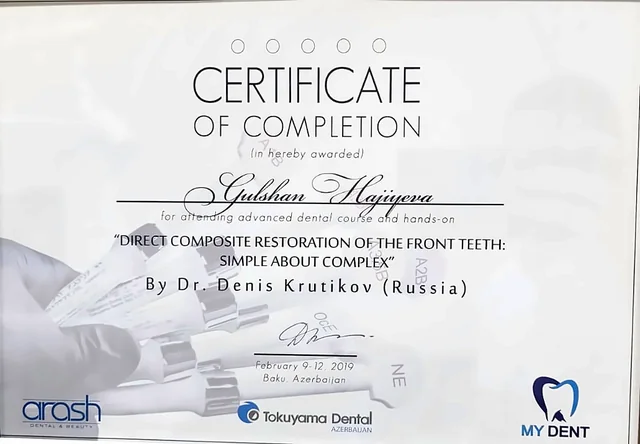
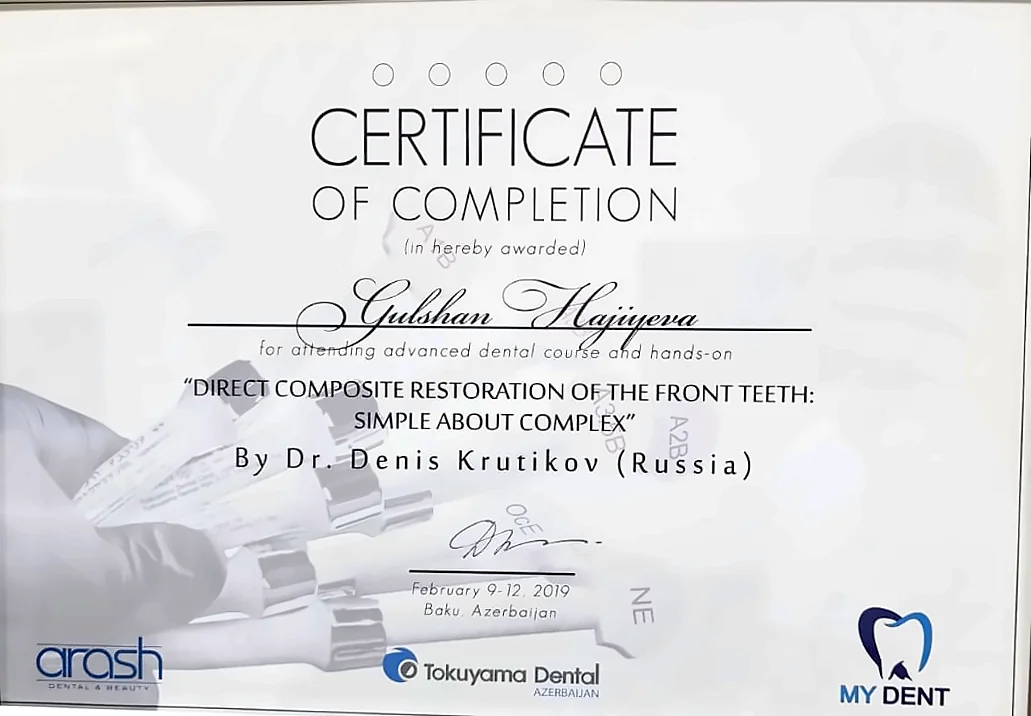
Hands-on course on direct composite restoration of the front teeth.

Training course: 360 minutes of hands-on restoration (Caspident, Sirona Academy).
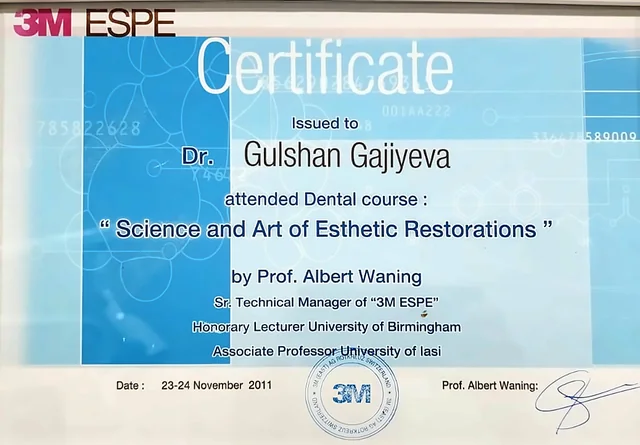
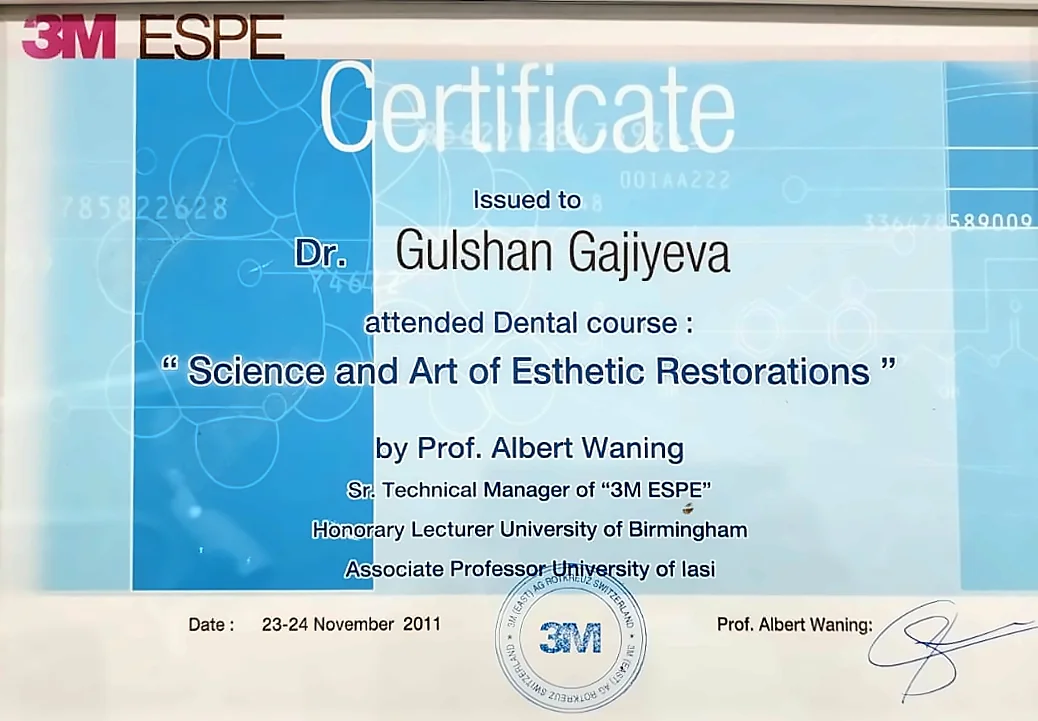
3M ESPE course on the science and art of aesthetic restorations.

International conference and master class on aesthetic restoration of teeth.

3M ESPE lecture course on aesthetic restoration of front and back teeth.

Scientific and practical seminar on clinical endodontics and aesthetic restoration (Moscow State University of Medicine and Dentistry).

Course on direct aesthetic and functional restoration of back teeth.







- 2026
Certificate to practise
State certificate to practise, dentistry
- 2019
Individual course on artistic restoration of front and back teeth (Style Italiano).
- 2002
University
Azerbaijan Medical University named after N. Narimanov
Other services

See a spot or a hole in a tooth?
Send a message on WhatsApp. The sooner decay is treated, the smaller the treatment.