Children's dentist in Baku
As a children's dentist, Gülşən Hacıyeva treats baby teeth and helps prevent decay. There is no rush: first the child and the dentist get to know each other, then the treatment starts.
Ask for the price: Children's dentistryThe exact price is clear after the examination.

Does this sound familiar?
- My child has a spot or a hole on a tooth
- My child complains about a tooth when eating sweets or cold food
- My child has a pimple-like bump on the gum
- My child fell and damaged a tooth
- My child is very afraid of the dentist
If the child's face is swollen, they have a temperature or they are very weak, do not wait: see a doctor the same day.
What does a children's dentist do?

If a child is very scared and will not open their mouth, the dentist does not treat them by force, because forced treatment makes the fear last for years.
- Filling The decay is removed and the tooth restored with a filling.
- Nerve treatment for baby teeth May be needed when the infection is deep.
- BioFlx crowns for baby teeth A badly broken-down baby tooth is covered with a white crown.
- Prevention When needed, fluoride varnish is painted onto the teeth and the grooves of the permanent back teeth are sealed.
- Taking out baby teeth When needed, a baby tooth is removed.
The youngest are treated under sedation, given by a partner mobile anaesthesia team that comes to the clinic. After the examination, a paediatrician decides whether it is suitable.
How does treatment go for children?

- How many visits
- Small decay is done in one visit, bigger work is split into several short visits.
- How long it takes
- A visit usually takes 20 to 40 minutes.
- Does it hurt
- Once the anaesthetic has taken effect, a child usually feels no pain, only pressure and vibration.
Getting to know each other
The child sits in the chair, meets the instruments, and the dentist counts their teeth. The parent is told what the examination shows.
A panoramic X-ray, if needed
If decay or infection is suspected that cannot be seen, a panoramic X-ray may be needed.
Anaesthesia
For deep decay local anaesthesia is given, with an anaesthetic gel on the gum first.
Treatment
The decay is removed and the tooth restored in one of the ways listed above. A visit usually takes 20 to 40 minutes: small decay is done in one, bigger work is split into several short visits.
Care at home
Parents get simple advice on brushing, sweets and night feeds.
After treatment and at home
- Do not give your child food until the numbness wears off, and make sure they do not bite their cheek or lip.
- At night, after brushing, give only water, not milk, juice or sweet tea.
- Give sweets after a meal, all at once, not throughout the day.


What does the price of children's dental care depend on?
The price depends on what needs doing. After the examination the plan and the price are agreed with the parent in advance. No extra work is done without your consent.
What changes the price
- How many teeth need treatment
- How deep the decay is: a filling, or nerve treatment
- Baby tooth or permanent tooth
- Prevention: fluoride varnish or fissure sealing
- Whether sedation is needed
Examples of work with children
Photos of children are shared only with their parents' consent and without faces.


Drag left and right, or use the arrow keys.
Frequently asked questions
Does dental treatment hurt for children?
Once the anaesthetic has taken effect, a child usually feels no pain, only pressure and vibration. For deep decay local anaesthesia is given, with an anaesthetic gel put on the gum first so the injection is hardly felt. The numbness lasts 1 to 2 hours: during that time, watch that the child does not bite their cheek or lip.
What do children's dental prices depend on?
The price depends on what needs doing: how many teeth need treatment, whether a filling is enough or nerve treatment is needed, and whether it is a baby or a permanent tooth. After the examination the plan and the price are agreed with the parent in advance. No extra work is done without your consent.
Baby teeth fall out anyway: do they need treating?
Yes. Some baby teeth stay until the age of 11 or 12. A decayed baby tooth hurts, your child cannot eat or sleep properly, and the infection can affect the permanent tooth growing underneath. If a baby tooth is lost too early, the neighbouring teeth drift, the permanent tooth has less room, and the teeth may later come in crooked.
At what age should a child first see a dentist?
Gülşən Hacıyeva sees children of any age. The first visit is best after the first tooth comes through, at about one year old. Usually there is no treatment at this visit: the teeth are checked, and brushing and food are discussed. Starting this early helps prevent decay and gets the child used to the dentist. Later check-ups depend on the child and the treatment, but come at least every 6 months.
How can I help a child who is afraid of the dentist?
Make the first visit a meeting, not treatment. You can stay in the room with your child. If the fear is very strong, a few short visits come first and, if needed, sedation is discussed. The youngest children are treated under sedation.
What should I do if my child has toothache?
Rinse the child's mouth with warm water and check whether food is stuck between the teeth. If a painkiller is needed, give only one made for children, following the pack instructions, or ask a pharmacist. Do not give aspirin or put anything on the tooth. Even if the pain goes, bring the child to the dentist. If the face swells and there is a temperature, see a doctor the same day.
My child's gum or cheek is swollen near a tooth: what should I do?
Swelling of the cheek or gum usually comes from an infection in a tooth. Bring the child to the dentist the same day. Do not warm the swelling and do not give antibiotics without a doctor's prescription. If the swelling spreads towards the eye or neck, a temperature rises or the child finds it hard to swallow, call an ambulance straight away (103).
Why do children get tooth decay?
Most often it comes from sweets eaten little by little all day, milk, juice or sweet tea at night after brushing, and teeth that are not brushed well. Baby teeth have thin enamel, so decay goes deep quickly. Brush with fluoride toothpaste from the first tooth and bring your child for a check-up at least every 6 months.
Read in more detail
Tooth decay in children: what signs to look for?
Decay in baby teeth often starts without pain and deepens quickly, so parents tend to notice it late. Once a month, in good light, lift your child's lip and look at the teeth, especially the upper front teeth near the gum and the chewing surfaces of the back teeth.
- A white chalky spot The earliest sign of decay. Usually there is no hole yet.
- A brown or black spot It may be decay, or sometimes just a stain. An examination shows which.
- Food keeps getting stuck between teeth Decay that starts between teeth is hard to see.
- Pain with sweet or cold food The decay has started to go deeper.
- A bump on the gum or bad breath The inflammation may have reached the root.
If you notice any of these, do not wait for pain: the earlier decay is found, the shorter and simpler the treatment usually is.
When do baby teeth come in and fall out?
Every child has their own timing: teeth coming in or falling out a little earlier or later is usually normal. The ages below are approximate.
The first permanent molar does not replace a baby tooth: it comes in behind the baby teeth at about age 6. Parents often take it for a baby tooth and notice decay late. These are the teeth whose grooves can be sealed.
- About 6 months The first baby tooth comes in, usually a lower front one.
- By age 2.5 to 3: all 20 baby teeth have come in.
- 6 to 8 years The front baby teeth fall out and permanent incisors take their place.
- 9 to 12 years The canines and baby molars are replaced.
If a permanent tooth comes in behind a baby tooth that is not loose, bring your child in. The same applies if a baby tooth is lost much too early after a fall or decay.
How to prepare your child for the dentist?
Your child should know in advance where you are going. The day before, say calmly that the doctor will count and look at their teeth. No long explanations. Avoid "don't be scared": it tells the child that something scary is coming.
- Timing Pick an hour when your child is fed, rested and not due for a nap.
- Words Avoid "needle", "hurt" and "drill". Say the doctor will count and clean the teeth.
- Play Count a toy's teeth at home, play doctor, read a children's book about teeth.
- At the visit You can stay in the room with your child. Stay calm yourself: children notice right away when a parent is nervous.
- Afterwards However the visit went, praise your child for being brave.
Home care by age
Most of the work of preventing decay happens at home. The rules change a little as your child grows, but the basics stay the same: brush twice a day with fluoride toothpaste and cut down on sweets.
- Before the first tooth You can wipe the gums with a clean damp cloth after feeding.
- First tooth to age 3 A soft children's brush and a rice-grain smear of fluoride toothpaste. At this age you do the brushing.
- Ages 3 to 6 A pea-sized amount is enough. Teach your child to spit the toothpaste out, not swallow it.
- After age 6 Permanent teeth come in. Where teeth touch, you can start using dental floss.
- Until about 7 or 8 Even if your child brushes alone, finish the job or check it afterwards.
The dentist's courses in this field
- years of experience, since 2004
- 20+
- courses and conferences in this field
- 3
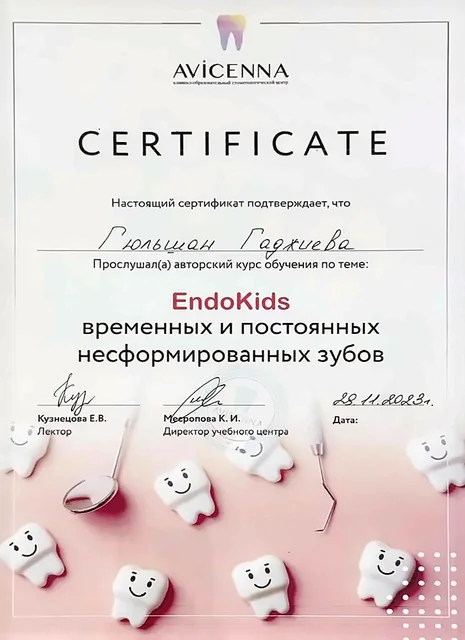
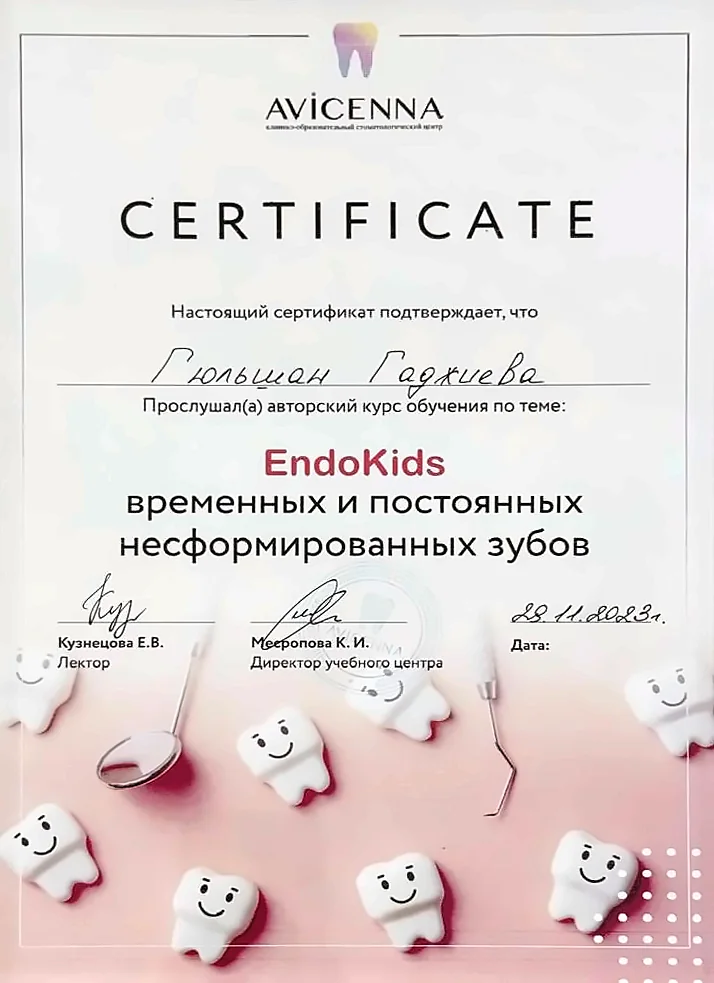
Course on root canal treatment of baby teeth and young permanent teeth with unformed roots.
- 2026
Certificate to practise
State certificate to practise, dentistry
- 2024
Course on orthodontics for children aged 0 to 14.
- 2023
Paediatric dentistry: aesthetic crowns for children, space maintainers and pulp therapy with e-MTA.
- 2002
University
Azerbaijan Medical University named after N. Narimanov
Other services

Worried about your child's teeth?
Send a message on WhatsApp with your child's age and what is bothering them. A good time is then found together.